Notes on Tunisia's "Voluntary Return" Programme
June 29th, 2026 - written by: migration-control.info, amended 02.06.26
An Independent Activist’s Monitoring Brief
This article examines the state-run "retour volontaire" (voluntary return) programme, initiated by the Tunisian government on July 7,2025. This programme has seen an aggressive logistical acceleration throughout the first half of 2026. This is not the IOM-assisted Voluntary Return programme. It is a separate process, organised directly by Tunisian authorities, operating with limited transparency and without any legal safeguards, or post-return monitoring, as usually associated with assisted return frameworks.
As we observed in our monitoring, people are registered, gathered, and documented through consular delegations when needed, and then transferred by bus to Tunis-Carthage Airport for return flights. The main hub of this process is the km 21 / El Amra area in Sfax, which has become a key transit point in the state-run retour volontaire system.
Yet focusing only on the final phase with it's clean transit tents, organised buses, airport queues and departure procedures, hides the conditions that often come before registration: months of police pressure, camp demolitions, arbitrary arrests, lack of shelter, lack of income, hunger, fear of detention, expulsion to the desert, and the absence of real protection alternatives.
- Geographic Focus: El Amra Transit Sites (Km 20 / Km 21), Sfax Governorate, Tunisia
- Temporal Frame: Ground observations and data compiled up to June 16, 2026
- Methodology: This monitoring brief breaks away from ,institutional language, in order to to document what is actually happening to people. We have integrated official state admission registries with our own continuous tracking of encrypted, migrant-led WhatsApp mutual-aid networks since June 2025. This quantitative reality is backed by a raw, 2 weeks and 3-day assessment on-site field, which I conducted in El Amra in June 2025 and May 2026, listening directly to people trapped inside the Km 21 transit zone, through confidential, semi-structured interviews.
1. Executive Summary
We need to be entirely honest about what the Tunisian state calls its sovereign "retour volontaire" (voluntary return) pipeline. The authorities try to market this mechanism, which runs completely outside the oversight of international frameworks like IOM, as an agile, compassionate, and orderly exit plan for irregular sub-Saharan communities. They claim that, by cutting through the multi-month bureaucratic delays and vulnerability screenings of international agencies, they are simply offering a faster way home.
However, if you look at the reality on the ground, this official narrative relies on a deliberate double truncation: it intentionally starts the clock too late, and stops it way too early.
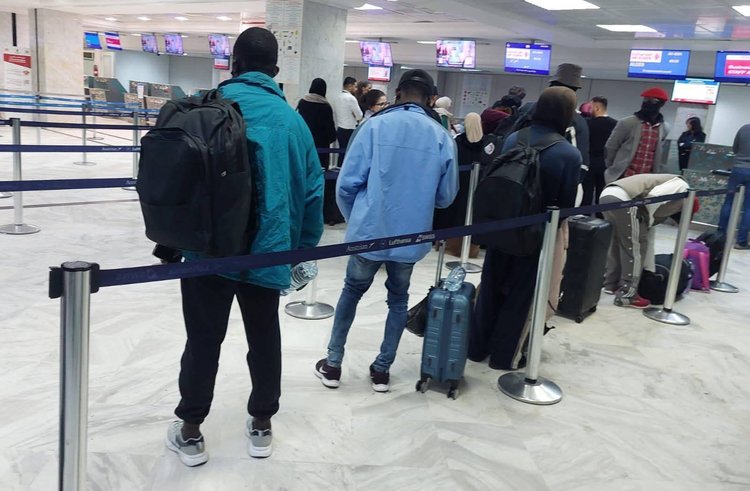
Luggage registration at Tunis-Carthage Airport
The state creates a carefully staged illusion of an orderly transition. They point cameras at the final 48 hours of a person’s stay in Tunisia, showcasing clean transit tents, baseline meal distributions, and quiet queues at the airport gates. This frame actively erases the horrific months that came right before: the state-enforced destitution, the tactical destruction of informal camps, and an economic blockade engineered to make basic human survival impossible.
At the same time, the state tracking mechanism cuts to absolute silence what happens after the deportation flight leaves Tunisian airspace. Once these planes touch down in West and Central African hubs, these people are dropped into absolute institutional anonymity. Their safety, their legal protection, and their ultimate fates are completely unmonitored and unrecorded by the state that pushed them out.
2. Logistical Reality: The Infrastructure of Accelerated Eviction
The speed at which the state is executing these evictions has aggressively accelerated through the first half of 2026. The camp at Kilometer 21 is not a passive reception center; it is a high-velocity assembly line designed to pull irregular sub-Saharan populations out of urban centers and agricultural fields across Tunisia, funneling them into Sfax for rapid-fire consular processing and removal.
Camp dismantling in Al Amra olive fields
Direct Operational Metrics (Updated to June 16, 2026)
- 4,735 Documented Removals: Official state figures now openly celebrate that 4,735 sub-Saharan individuals have been permanently processed and pushed out through this specific state-run pipeline since July 2025. This apparatus operates completely separate from traditional international voluntary return tracks, as my monotoring about more than 5000 persons, including children, shows.
- Forced Aggregation at Km 21: The isolation facility near El Amra currently detains a rotating population of 574 so-called irregular migrants. To keep this assembly line supplied, Guard National units execute 2 to 4 trans-regional bus rotations every single week (La Presse de Tunisie), constantly bringing in newly intercepted cohorts.
- Violent Compression of Rights: While real protection standards demand a deep, multi-layered evaluation of health vulnerabilities and political asylum risks, this state-run system relies on an extreme protocol compression. Individuals are swept up, processed for emergency travel papers by rotating consular delegations, and driven straight to Tunis-Carthage Airport for departure, sometimes within a tiny 72-hour window .
- The Regional Dragnet: Guard National has weaponized its logistics far beyond the Sfax olive groves. Security forces are executing coordinated raids in outlying governorates, specifically hunting for migrants in Grand Tunis (the Ariana and Berges du Lac areas), Nabeul, and Sousseand, packing them onto state buses bound for the El Amra transit camps.
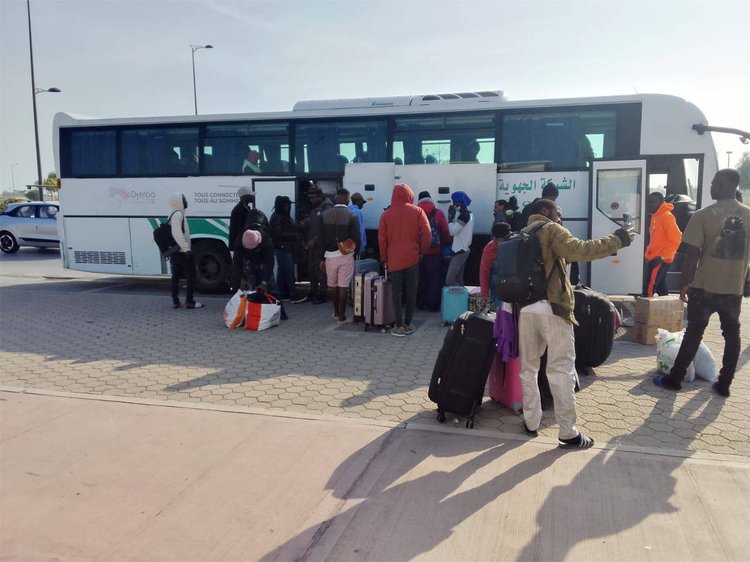
Pick-up point in Lac 1, Tunis
3. The Post-Arrival Black Hole: Total Disappearance
The public relations show put on by the authorities ends abruptly on the tarmac of Tunis-Carthage Airport. For human rights monitors activist networks, and panicked families, this is where the most dangerous phase of this program begins: the post-landing void.
Our monitoring of community-led WhatsApp communication networks, which we have tracked every single day since June 2025, proves that despite intense peer-to-peer tracing efforts, the post-arrival environment is a complete information black hole.
There is an absolute absence of verified data on what actually happens to these human beings once they step off the planes in Guinea, Mali, or Côte d'Ivoire. We have zero verification of their physical safety, whether they have shelter, or whether they have faced immediate retaliation from predatory migration debts or political reprisal.
The pattern across our digital mutual-aid networks over the past year is terrifyingly consistent:
- The 24-Hour Buffer: While sitting on the plane, individuals maintain active WhatsApp profiles, sending final, anxious messages to friends still hiding in the El Amra olive groves.
- The Terminal Silence: Within 24 to 72 hours of landing at the destination hub, phone lines systematically go dead. SIM cards are dropped, digital profiles vanish or stay permanently inactive, and peer messages stay unread and undelivered.
This is not a coincidence. This total fracture is driven by structural forces:
- Hardware Seizure: Transit security or destination state security frequently confiscate or force the disposal of phones during arrival processing.
- Complete Financial Exhaustion: Returnees land with absolutely nothing, leaving them completely unable to purchase local SIM cards or mobile data.
- Social Shunning: People intentionally isolate themselves, hiding from the severe social stigma and familial shame of returning empty-handed from a highly dangerous, debt-heavy migration attempt.
Many migrants are induced to sign formal state registries, because they are told or led to believe by informal camp handlers that reintegration stipends, housing assistance, or cash packages are waiting for them at home. Because independent civil society and legal observers are strictly barred from tracking these individuals post-landing, there is zero proof that this aid actually exists.
An airplane ticket under these conditions is not a "humanitarian solution." It is an administrative eviction. A bottle of water and a meal bag before takeoff cannot replace real human rights protection. Shutting down all tracking the moment a plane hits the ground is a profound violation of international monitoring norms.
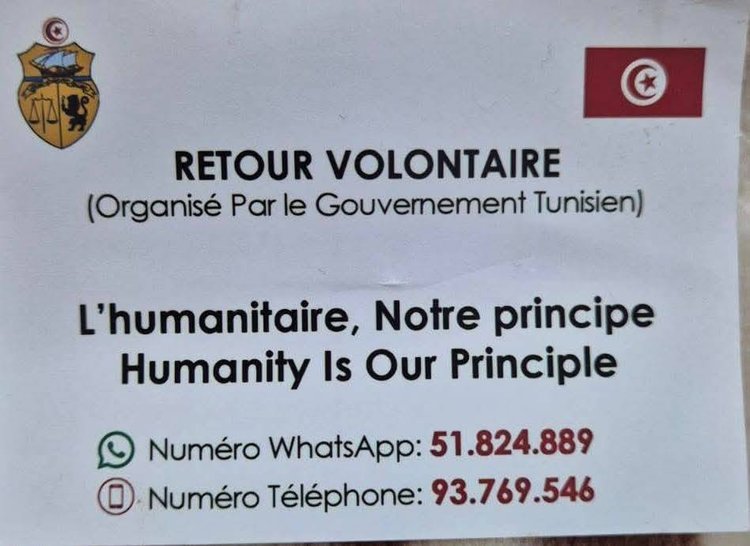
Retour volontaire contact card
4. The Weaponization of "Humanitarian Shielding"
A major tactical shift occurred in May 2026 when the Tunisian Red Crescent (CRT) was brought in to manage the internal infrastructure at the Km 21 camp. My 3-day on-site assessment in May 2026 makes it clear that we must look at this integration with extreme criticality.
By giving the Red Crescent exclusive access as the only actor present besides Guard National, on mid-May 2026, the state has effectively traded genuine independent legal monitoring for controlled humanitarian visibility. While the CRT presence ensures baseline physical survival, hot food, basic medical triage, and tarps, it acts primarily as a "humanitarian shield" to sanitise the eviction process for international onlookers.
Testimonies I gathered from inside the fields in May 2026 expose the reality behind this managed image:
- The Staged Openness: The facility is run as a strictly closed, extrajudicial zone. Carefully curated visits for foreign diplomatic delegations are restricted to showing off functional kitchens and clean water lines and children playing football.
- The Access Blockade: This humanitarian face hides the fact that people are completely denied freedom of movement. Entry and exit are under heavy military guard, independent human rights activist and NGO are aggressively blocked from entering, and individuals are totally isolated from any legal actors who could help them.
Putting a humanitarian band-aid on Km 21 does not change its core function: it is an extrajudicial sorting mechanism built to isolate sub-Saharan migrants and accelerate their expulsion.
5. How Coercion is Manufactured
For a "voluntary return" to be legally valid under international law, free will must actually exist. But the testimonies which we collected from the fields around El Amra prove that this "choice" is completely manufactured through the systematic state-enforced destruction of any alternative path to survival.
The state uses three brutal vectors of coercion to force compliance:
A. Material Erasure and Asset Striping
Before anyone ever sets foot in the Km 21 registration line, Guard National units subject them to relentless, traumatising raids. They bulldoze informal tarp settlements, burn personal belongings, and systematically confiscate or smash phones, identity papers, and whatever cash savings people have managed to scrap together. This strips individuals of the basic material means to survive or navigate an alternative route.
B. The Socio-Economic Blockade
The state has viciously criminalised the local population's economic interactions with irregular sub-Saharan migrants. Tunisian citizens face massive fines or prison time for renting an apartment to a migrant, or for hiring them for day labour in agriculture. By shutting down the informal economy, the state has forced thousands of people into a state of forced starvation in rural olive groves, cut off from food markets and medical care.
C. The Threat of Desert Refoulement
Every single person I interviewed in May 2026 expressed an acute terror of what happens if they refuse to sign the return paperwork. The alternative to the flight pipeline is not being left alone. It is the immediate risk of arbitrary arrest, followed by extrajudicial pushbacks to the highly dangerous, militarised desert borders with Libya and Algeria.
When every single mechanism of daily human survival is structurally dismantled by state policy, choosing to board a flight is not an act of free will. It is a mandatory strategy to avoid physical violence and starvation.
6. Children: No Protection Red Lines
The high-velocity nature of this state-managed pipeline creates severe, immediate dangers for children who are swept into the machine to meet rigid flight schedules. Our monitoring reveals that basic child welfare standards have been completely tossed aside for the sake of logistical speed.
- Zero Best-Interests Assessments (BIAs):There is absolutely no independent child protection infrastructure, specialized social work body, or juvenile legal representation inside Km 21.The accelerated timeline completely bypasses BIA protocols, which legally require a deep evaluation of a child's safety and psychological state before any return can be authorised.
- Guardianship Vulnerabilities: Consular authorities operating under massive time pressure issue emergency travel documents based almost entirely on rapid visual verification. No independent, rigorous legal checks are performed to ensure that accompanying adults are actually the biological parents or lawful guardians of the minors in their group.
Document Seizure and the Unlawful Imprisonment of Minors
Field data and peer-to-peer tracing verified up to June 2026 expose a terrifying escalation in how security forces treat unaccompanied sub-Saharan children.
The Systemic Criminalisation of Kids: During regional sweeps, multiple unaccompanied minors were arbitrarily arrested by security forces. When caught, these children presented valid, official papers including birth records, consular age certificates, and passports proving beyond any doubt that they were legally under 18 years old.
In direct violation of international human rights law, security forces forcefully snatched and suppressed these age-verifying documents. Instead of handing these children over to juvenile protection agencies, authorities treated them as irregular adults. They were thrown into standard adult penal facilities, where they were forced to serve out multi-month prison sentences inside severely overcrowded adult cells.
This practice of document confiscation and penal isolation actively strips children of their legal identities, exposes them to profound physical and psychological danger, and cuts off any path to family reunification.
7. Shifting the Focus: Moving Beyond the Optics
The state-managed return machine operating in Sfax is a calculated intersection of hardline border enforcement and humanitarian optics. It serves European externalised border agendas by stopping visible migrant boats from crossing the central Mediterranean, while fulfilling domestic political promises to violently purge sub-Saharan populations from visible coastal zones.
As human rights activists and monitors, we cannot allow the state propaganda to dictate where this story begins and ends. Orderly check-in lines and clean airport queues show logistical efficiency, but not human dignity.
Until we account for the state-enforced violence happening in the olive fields before registration, and until we shine a light on the terrifying post-arrival black hole that awaits these people on the ground, this program cannot be labelled as a humanitarian choice. It must be exposed for what it truly is: a highly institutionalised system of mass eviction driven by structural coercion, in line with the European externalisation of refugee repulsion.