Pushbacks to Libya from Maltese SAR at all-time high
May 21st, 2026 - written by: Malta Migration Archive
The Maltese Search and Rescue Zone in the central Mediterranean Sea has seen more pushbacks to Libya in the last year than ever before. Agreements struck between the EU and its member states, including Malta and Italy, and the militias controlling the Libyan coastline have facilitated these pushbacks.
The Malta Migration Archive was launched in June 2025 and advocates against such border violence by Malta and the EU.
2025 was another disastrous year for sea rescue in the central Mediterranean. There have been several shipwrecks and more than 1,330 people died at sea. Civil sea rescue is still being obstructed by the so-called Piantedosi law that allows the Italian government to detain ships on tenuous grounds. In parallel, the government systematically assigns distant ports for disembarking rescued persons in the North of Italy, thus keeping rescue vessels away from their areas of operation. While the Decree is being challenged within Italian courts, it still remains the legal framework designed by the Italian government to render sea rescue even more difficult. Collaboration with the so-called Libyan Coast Guard has also intensified, despite multiple violent incidents. Boats from the so-called Libyan Coast Guard, financed by the European Union, fired shots at the Sea-Watch 5 in May 2026, after also shooting at the Ocean Viking last year and regularly firing at boats in distress.
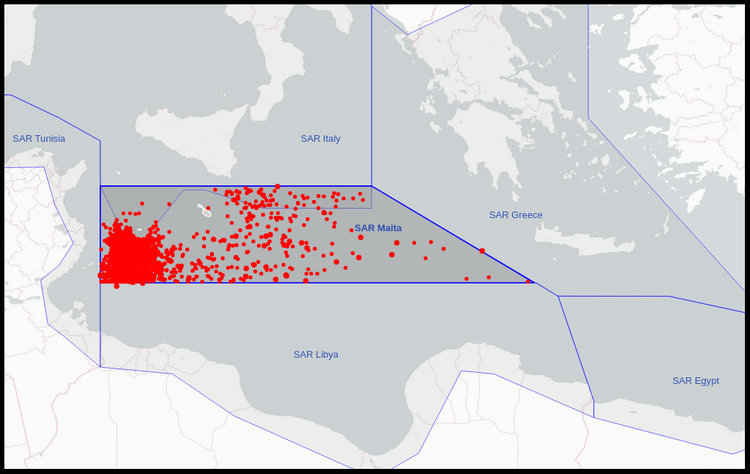
How does this concern Malta? The island lies along the route from Egypt, Libya and Tunisia towards Italy and has a Search and Rescue (SAR) zone where it is obliged by international law to attend to distress cases. As our data now shows, Malta fulfills this duty less and less and regularly refuses to facilitate rescues. In parallel, the Maltese authorities increasingly allow boats from the so-called Libyan Coast Guard to enter the Maltese SAR zone to violently intercept boats in distress and forcibly return them to Libya where they face severe, well-documented, and widely condemned human rights abuses.
In collaboration with the Civil MRCC and its SARchive, the Malta Migration Archive documents Malta’s non-assistance to people in distress at sea and its complicity in pushbacks, in order to demand that the Maltese government change its course of action. Sea rescue is an obligation that Malta conveniently forgets or outsources. The consequence, the loss of moral integrity, is reflected in the following data.
In 2025, at least 565 cases of boats in distress occurred in the Maltese SAR zone with 23,568 people on board. These numbers are similar to previous years, however activity by the so-called Libyan Coast Guard within the Maltese SAR zone increased. The so-called LCG carried out 34 pushbacks from within Malta’s SAR zone in 2025, an increase from 20 in 2023 and 24 in 2024. In 2025, this means that more than 1,550 people were returned to certain violence in Libya.
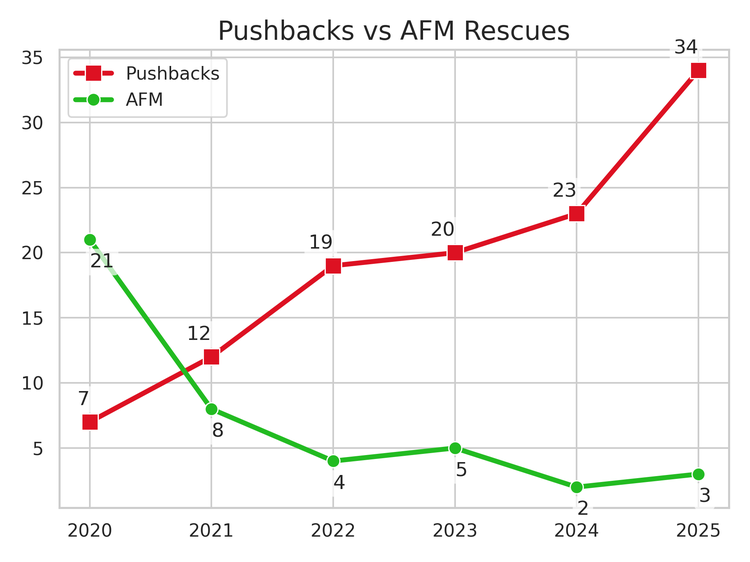
Rescues by the Armed Forces of Malta (AFM) on the other hand are pitifully low. For the 565 cases that were documented last year, the Maltese Armed Forces only rescued three boats. The trend is clear: Malta rescues people less and less while allowing increasing numbers of people to be forced back to Libya. Pushbacks to Libya are illegal as they contravene the principle of non-refoulement, while also making Malta and the wider EU complicit in Libya’s inhuman machinery of detention, abuse and extortion. Malta must not allow the so-called Libyan Coast Guard in their SAR zone.
The Malta Migration Archive was launched in June 2025 and advocates against such border violence by Malta and the EU. It documents the non-assistance of the Maltese authorities and reveals what has occurred in the Maltese Search and Rescue zone since 2020. Participating in various events, the Malta Migration Archive stands in solidarity with people in distress at sea and with people suffering from the Maltese migration practices. It is part of the El Hiblu 3 Coalition and tries to give people a voice to report the difficulties they have with the Maltese migration authorities.