Weaponising Sovereignty: The Rise of the "No to Resettlement" Movement
October 1st, 2026 - written by: Birimi Jihed
By late August 2026, the main entrance to the UN Refugee Agency (UNHCR) compound in Tripoli's Al-Sarraj district had been blocked with earth berms and welded shut with iron bars. Two weeks later, on 7 September 2026, the escalatory pattern reached a violent peak when activists targeted an International Organisation for Migration (IOM) humanitarian centre in Al-Siyahiya, physically breaching the compound, assaulting staff and asylum seekers, and forcing an immediate, indefinite shutdown of protection operations.
Two months prior to these actions, representatives of the movement claiming credit were seated inside the Ministry of Interior, receiving formal institutional validation from Minister Imad Al-Trabelsi.
What began as a network of localised Facebook pages, Telegram channels, and legal petitions has evolved into an effectivepressure campaign across western Libya. The "No to Resettlement" campaign draws on an existing activist network previously known as the "Tripoli Activists Movement," whose activities addressed economic and social grievances and demands for elections. Its subsequent focus on migration brought these networks into a pressure campaign across western Libya. Operating under slogans such as "Libya for Libyans," lawyers, civic activists and neighbourhood organisers have combined online mobilisation, demonstrations and legal challenges with physical blockades of UN premises. The movement shift in focus matters: a network previously mobilising around political and economic grievances now directs its pressure towards non-Libyans and the organisations providing them with assistance.
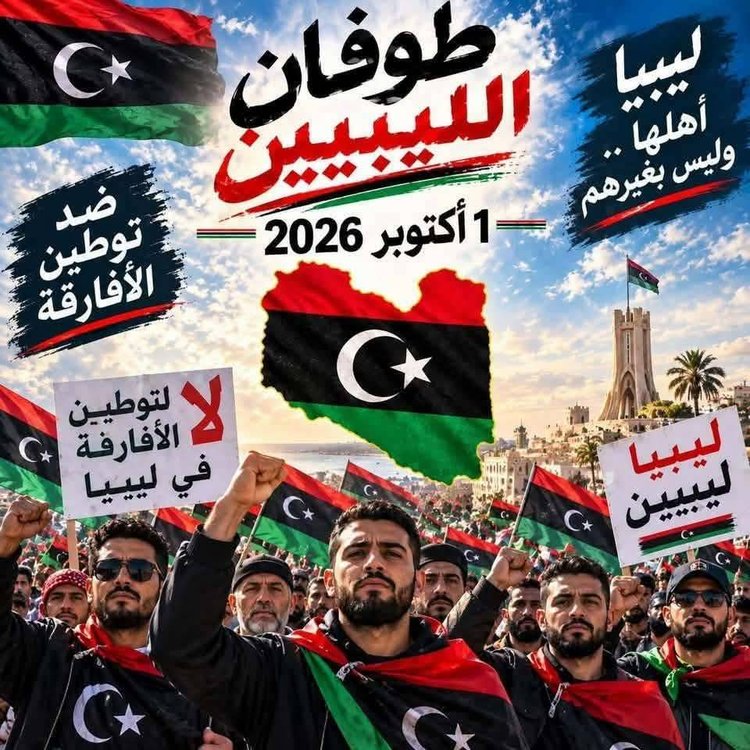
Time Table of Events
Late 2025: Digital Panic & Online Mobilisation.
May - June 2026: Legal Campaign & Public Advocacy:
- Court Ruling: Appeal Court suspends Decree 49/1990.
June 8, 2026: Institutional Validation:
- Interior Minister Emad al-Trabelsi receives "No to Resettlement" movement.
August - September 2026: Physical Escalation & UN Blockades
- UNHCR Al-Sarraj Compound welded shut on August 22/23
- IOM Al-Siyahiya Facility breached & blocked on September 7.
Mid-to-late September 2026: Regional Expansion & Ultimatum
- Misrata Anti-Settlement Movement holds Victory Square rally
- Issuance of 1 October mass mobilization deadline for irregular foreign residents
Mapping the Ecosystem: Nodes, Slogans, and Public Faces
The campaign is not directed from a single center. It is a shared framework adopted by distinct local groups that coordinate online and converge during physical actions. The "No to Resettlement" ecosystem consists mainly of the "Tripoli Activists Against Resettlement", which organised neighborhood blockades and compound shut-offs, legal advocacy actors, filing administrative lawsuits and the "Misrata Movement Against Foreigner Settlement", which organises public rallies
Primary Formations
- “Tripoli Activists Against Resettlement” (Hirak Nusata Tripoli Did al-Tawteen): The most active operational branch in the capital, responsible for organising demonstrations outside public prosecution offices and coordinating physical blockades of UN facilities in Al-Sarraj and Al-Siyahiya.
- “No to Resettlement" movement: The overarching umbrella identity used across social media platforms, television appearances, and formal political manifestos.
- Regional Networks (e.g., The Misrata Movement Against Foreigner Settlement): Local chapters that have emerged outside Tripoli, adopting identical slogans and framing migration as an existential threat to municipal identity.
Key Public Figures
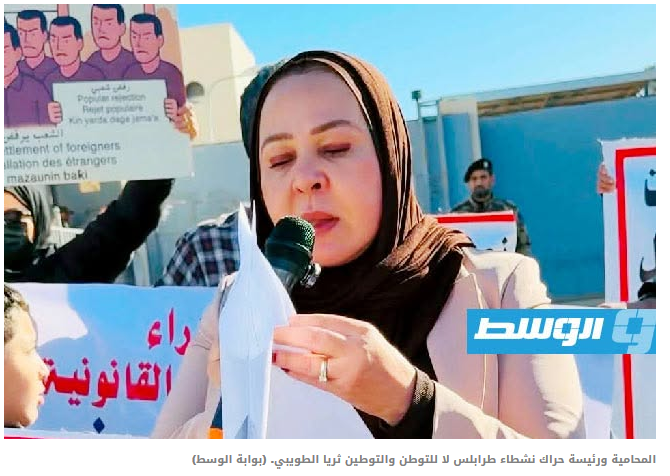
Rather than formal leadership, the "No to Resettlement" movement relies on public figures who articulate its legal and nationalistic arguments. A loose online campaign transformed into a physical movement when economic exhaustion in western Tripoli suburbs (Janzour ,Al-Siyahiya, Abu Salim) fused with high-profile media amplification, notably through lawyer Thuraya al-Tuwaibi's media appearances demanding the expulsion of international agencies and challenging administrative regulations granting non-citizen rights.
Thuraya al-Tuwaibi, Lawyer and Legal Advocate
Serves as one of the primary public voices. Her focus centres on administrative litigation and public advocacy. She successfully led legal challenges against state administrative decisions that granted socio-economic rights to long-term non-citizen residents.
Salma al-Shaab, Civi Spokesperson
Regularly appears in local broadcast media and online forums. Her rhetoric focuses on demographic anxieties, potential alterations to the national civil registry, and demands for the strict enforcement of foreign labor restrictions.
2. Chronology of Escalation (Late 2025 – September 2026)
Phase 1: Digital Incubation (Late 2025 – May 2026)
Throughout late 2025, network channels across Facebook, Telegram, and TikTok circulated unverified reports claiming that international organisations were secretly issuing civil registry numbers, long-term residency permits, and housing allotments to non-citizens. These narratives conflated UNHCR's standard refugee registration and vulnerable case documentation with state citizenship procedures. Activists also mischaracterised the European Union’s Pact on Migration and Asylum, presenting it as a plan to convert North Africa into a permanent holding ground for displaced populations.
Phase 2: Legal Action & Institutional Validation (June 2026)
8 June 2026: GNU Interior Minister Imad al-Trabelsi held an official meeting in Tripoli with representatives of the "No to Resettlement" movement. Trabelsi affirmed the ministry's alignment with their opposition to foreign settlement, stating that Libya would not serve as a transit zone or a permanent residence for undocumented migrants.
23 June 2026: The movement achieved a significant legal outcome. The administrative chamber of the Tripoli court of appeal ruled to suspend executive procedures related to Decree 49/1990—a historic regulation that had granted specific Arab national populations equal access to public employment, civil service pay structures, and administrative rights. Lawyer Thuraya al-Tuwaibi publicly celebrated the verdict as a victory for state sovereignty.
Background on the Decree 49/1990 litigation: The decree equalised administrative and employment rights for selected foreign national groups in Libya. In June 2026, the movement filed an administrative lawsuit citing constitutional equality principles. As a result, the Tripoli court of appeal suspended implementation, legally reclassifying beneficiaries as foreign labor subject to standard work permit regulations.
Phase 3: Physical Blockades & The September Escalation (July – September 2026)
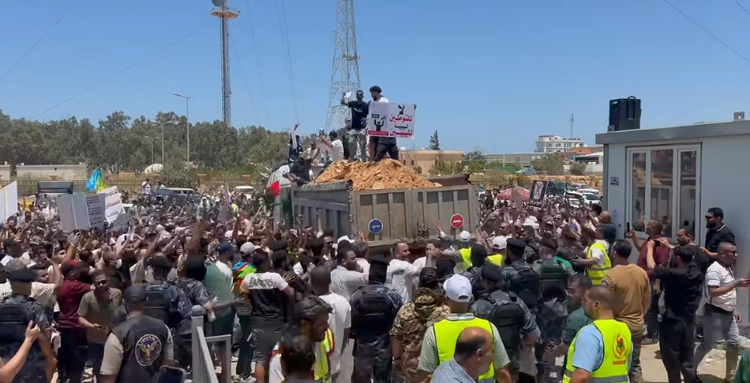
22–23 August 2026: Activists targeted the main UNHCR compound in Tripoli's Al-Sarraj district. Protesters brought heavy materials, dumped earth berms across access paths, and welded the main entry gates shut to prevent staff and visitors from entering.
7–8 September 2026 (The Al-Siyahiya IOM Assault): Direct action against international actors turned violent. protesters breached and stormed the IOM humanitarian centre in Tripoli’s Al-Siyahiya district. According to reporting by human rights monitors, individuals inside including staff, vulnerable migrants, women, and children seeking assistance were physically assaulted. Activists subsequently erected concrete barriers and earth berms across entry points, permanently halting Voluntary Humanitarian Return (VHR) registrations, medical consultations, and emergency aid processing.
Sources:
- https://www.facebook.com/61590326501744/posts/-serious-concern-in-tripoli-according-to-a-report-by-libya-crimes-watch-an-attac/122133455253344216/
- https://www.facebook.com/61590326501744/posts/-serious-concern-in-tripoli-according-to-a-report-by-libya-crimes-watch-an-attac/122133455253344216/?,
- https://www.facebook.com/AJA.Libya/videos/1612062906995556/,
- https://www.youtube.com/shorts/9HonEkntqqc
15 September 2026: The Tripoli activist core issued a formal political manifesto. The document threatened legal action against state institutions maintaining operational partnerships with European migration organizations, demanding full enforcement of Law No. 6 of 1987 regarding the entry and residence of foreigners.
18 September 2026: The "No to Resettlement" movement expanded geographically. In Misrata, the local anti-settlement movement organized a public rally at Victory Square, calling for immediate mass deportations, according to an official statement published by the Libyan News Agency.
Late September 2026 – The October 1 Mobilisation Deadline: Intensifying their pressure, figures associated with the "No to Resettlement" movement have presented October 1, 2026 as a deadline for undocumented foreigners to leave or face removal. This public ultimatum is circulating alongside calls for demonstrations and reported threats from social media accounts linked to militia members, including posts displaying weapons. Reports of a large arrest campaign by authorities in Tripoli deepen this climate of fear: people are threatened online while being hunted in the streets. After the attacks on humanitarian offices, there is a serious concern that the mobilisation will encourage further assaults and forced evictions. People are being told to leave while the spaces where they can seek protection are being closed and safe routes out remain blocked.
3. Geography of Mobilisation: Regional Asymmetries and Social Base
While "anti-settlement" rhetoric has been adopted by political and security institutions across Libya, a structural assessment reveals major geographic and social variations.
Regional Divergences: Visible street mobilizations, compound seizures, and direct-action blockades have been heavily concentrated in western Libya (greater Tripoli, Janzour, and Misrata) . By contrast, while southern Libya (Fezzan) and eastern Libya experience heavy security crackdowns and deportations, they lack a comparable ecosystem of sustained, autonomous neighborhood street protests. In the South, security is heavily militarized under the LAAF/General Command or local tribal dynamics, leaving little space for decentralised civilian street activism. In northern Cyrenaica, institutional anti-migrant directives dictate security sweeps rather than organic civic campaigns.
Social Composition: The movement visible leadership relies heavily on middle-class professionals, specifically lawyers, municipal figures, civic activists, and online organizers while the broader participant base draws from economically squeezed suburban youth and neighborhood networks.
4. The Politics of Nativism, Race, and "Libya First" Belonging
Although "No to Resettlement" activists meticulously frame their platform through the neutral, technocratic language of state sovereignty, labor regulations, and legal petitions, the movement on the ground operates on a foundation of strict, exclusionary nativism.
A vital analytical nuance is that this nativism is not driven by a traditional Pan-Arab solidarity framework. While the movement's rhetoric targets Black and racialised sub-Saharan migrants with acute, street-level racialized violence, harassment, and scapegoating, its legal and administrative campaign has been equally aggressive toward other Arab nationalities. This is most clearly demonstrated by the movement's legal assault on Decree 49/1990, a historic regulation that granted specific Arab national populations (such as Syrians and Palestinians) equal access to public employment, civil service pay structures, and administrative rights in Libya.
By successfully mobilizing to suspend Decree 49/1990 and demanding the strict enforcement of the 1987 Foreigners Law against all non-citizens regardless of origin, the movement reveals that its core ideological driver is not pan-Arab fraternity, but a defensive, hyper-nationalist "Libya for Libyans" doctrine.
This recurring language of protecting Libya's demographic and cultural "purity" raises a deeper question of civic exclusion: who is imagined as belonging to the Libyan nation? By treating all foreign labor ,refugees, and long-term regional residents as an existential demographic threat, while weaponizing anti-Black racism on the streets and stripping historic legal rights from Arab residents in the courts, the movement re-draws the boundaries of Libyan citizenship through total exclusion, flattening Libya's diverse regional, Amazigh, Tebu, Tuareg, and cosmopolitan histories into an aggressively closed domestic fortress.
5. State-Militia Subcontracting: Tolerance and Support
A central analytical question is why a group of civilian activists was permitted to physically assault and seal off international diplomatic and humanitarian compounds in heavily monitored districts of Tripoli.
In the western Libya security landscape, territory is partitioned among state-affiliated armed groups. Al-Sarraj and Al-Siyahiya operate under specific security umbrellas where unauthorised public gatherings are routinely dispersed. The unhindered deployment of earth trucks, concrete blocks, and welding equipment outside UN premises culminating in the September 7 breach of the IOM facility required at least passive non-intervention from local security entities. Government, security and non-state actors are connected here though a mutually beneficial dynamic:
- Official Need: Government seeks to limit international oversight and slow protection registrations without breaking ties with EU.
- Street Execution: The "No to Resettlement" movement deploys physical blockades and frames actions as "defending national sovereignty."
- Security Passivity: Local security units maintain neutrality, citing public sensitivity and allowing physical compound closures.
- Political Outcome: Protection spaces are shut down while authorities preserve formal diplomatic deniability.
This dynamic illustrates a model of state-militia subcontracting that provides diplomatic power as official state entities cannot easily expel UN agencies without jeopardising diplomatic relationships and international assistance programs. At the same time, they can disrupt international agencies work by allowing the "No to Resettlement" movement to physically enclose compounds and assault operational centre. Thus, authorities achieve an operational freeze on international protection and registration without issuing formal administrative eviction orders. Security forces on their part present their non-intervention as deference to public sentiment, shielding the state from direct accountability for violations of international agreements protecting humanitarian facilities.
The Role of the ICC trial against Khaled Al-Hishri
During mid-2026, international headlines focused on proceedings at the International Criminal Court (ICC) regarding Khaled Al-Hishri, a former senior official at Tripoli's Mitiga prison complex associated with the Special Deterrence Forces (RADA). Following the confirmation of 17 charges of war crimes and crimes against humanity, details surrounding Al-Hishri's custody status were made public, and the ICC announced that his trial date is set for May 2027.
While some policy analysts suggested that local armed factions permitted the attacks on UN compounds as retaliatory leverage against international judicial pressure, primary sources show a distinct focus.
Statements, speeches,and published manifestos from the "No to Resettlement" movement focus consistently on domestic demographic fears, foreign labor regulation, and municipal security. They rarely cite ICC proceedings. The ICC proceedings contributed to broader institutional friction between local security actors and international bodies. However, treating the anti-resettlement blockades strictly as a proxy operation for detained commanders oversimplifies a movement rooted in genuine domestic political and legal dynamics.
6. Measuring the Movement's Real Impact
To assess the campaign's significance, its outcomes must be measured across institutional, legal, operational, and symbolic levels that were described above. Overall, it has gained institutional validation through direct ministerial meetings and the official adoption of "anti-settlement" rhetorik by state authorities. Symboliccaly, the "Libya for Libyans" narrative has been broadly adopted and amplified across major broadcast networks. Legally, the suspesion of decree 49/1990 has been a success for the movement and there are increased petitions which airm to enfore the 1987 Foreginers Law. In terms of actions, the blockades of IOM and UNHCR premises directly altered international operations on the ground.
The September 7 attack and subsequent blockade of the IOM centre in Al-Siyahiya severed critical lifelines. Vulnerable asylum seekers, medical referral patients, and victims of trafficking lost direct access to emergency aid andprotection caseworkers.
The forced closure of IOM facilities halted administrative processing for Voluntary Humanitarian Return (VHR) flights, leaving migrants stranded in official detention centers or exposed to exploitation in informal housing sectors. While international humanitarian protection operations face physical shutdowns, state-managed containment, arrests, and unilateral deportation operations continue uninterrupted.
7. Fact-Checking the "Resettlement" Narrative
The primary claim driving the "No to Resettlement" movement is that international agencies are actively working to permanently settle non-Libyan populations inside the country. Examining these claims against institutional frameworks highlights significant discrepancies:
The Movements Claims
- "UNHCR gives migrants citizenship and civil registration numbers."
- "The EU Migration Pact legally forces Libya to accept permanent settlement."
- "Protection programs aim to keep refugees in Libya permanently."
Factual and Legal Reality
- UNHCR documents provide internal group protection tracking only; they have no standing in national civil registries.
- The EU Pact binds EU member states; it contains no legal mechanism to grant permanent residency inside non-EU states
- Resettlement programs move refugees out of Libya to third countries (e.g., via Emergency Transit Mechanisms).
Yet despite the movements unfounded claims, the narrative resonates broadly due to underlying social anxieties. Years of political division, economic strain, liquidity shortages, and visible external interference have created fertile ground for nationalistic framings and mobilisation. Many Libyans view European border externalisation efforts with scepticism, suspecting that European policies aim to convert Libya into a permanent containment zone. The "No to Resettlement" movement redirects these legitimate anti-externalisation concerns toward international humanitarian workers and non-citizen labour populations.
The Externalisation Paradox: Selective Sovereignty
The rise of the "No to Resettlement" movement highlights a fundamental paradox in Libya's current migration management framework. Sovereignty is asserted aggressively against international protection agencies, human rights monitoring, and refugee registration, but set aside when accepting foreign equipment, border infrastructure funding, and security and intelligence training.
While activists block UN doors in the name of national dignity, state security institutions continue to engage with external partners to build up interdiction and border enforcement capacities.
Detention and Containment: The Directorate for Combating Illegal Migration (DCIM) maintains operational control over detention centres, utilising state budget allocations and international equipment support to manage interdicted populations.
State Deportations: State agencies regularly publicise synchronised deportation airlifts and land convoys from Mitiga, Benina, and Kufra. These operations operate with limited international oversight, presenting mass expulsion as an assertion of state authority. By tolerating the "No to Resettlement" movement, Libyan authorities successfully shift the public debate. The core policy dilemma is no longer framed around the conditions of detention or the legality of maritime interdictions, but around defending the nation against a perceived international conspiracy. In this environment, international protection agencies are pushed out, state security bodies expand their mandates, and vulnerable populations bear the consequences of a shrinking humanitarian space.
The reported threats surrounding October 1st are public. European governments and institutions cooperating with Libyan authorities have been warned of the danger. They must act before these threats become further attacks, demand protection for those targeted and stop support that enables abuses. Waiting to condemn the violence afterwards is not enough.
Please also See:
Refugees in Libya: October 1 in Libya: An Unverified Deadline, Real Threats Telling Refugees to Leave or Face Death
ND 30.09.26 (Wasil Schauseil):Gewalt in Libyen: Die Angst vor dem 1. Oktober wächst