What is Externalization?
Published March 15th, 2020 - written by: migration-control.info
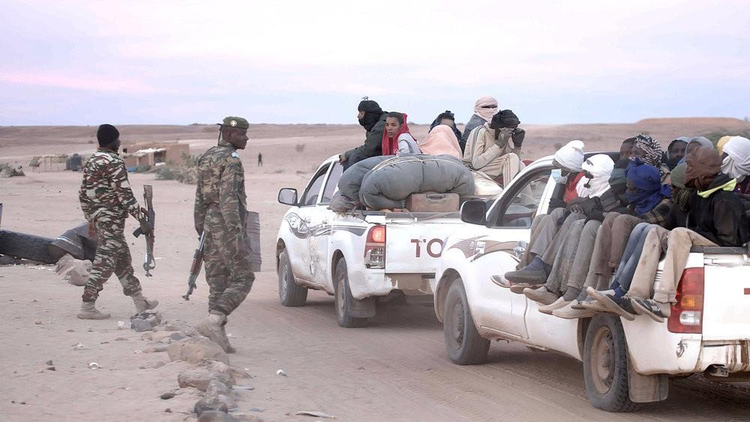
(C) Thomas Schneider
What is externalization and how did it come into place?
Migration externalization refers to the outward shifting of borders and control measures. In the EUropean context this practice evolved with the Schengen zone established in the early 1990s, which created a shared external border. The Treaty of Amsterdam in 1999 brought communitarization of migration and asylum policies. European countries began working with neighbouring states to filter and contain mobility toward the EU.
Two central axes define these externalization measures. Security oriented approaches frame migration as containing security threats. These measures involve the fortification of borders, including expanding surveillance or providing equipment, training and intelligence. This is often refered to as “capacity building”, often to the benefit of security forces, police, border guards and militia groups.
Externalization also refers to political and diplomatic measures aiming to push countries to cooperate in migration control, containment or deportation of unwanted populations. With the emergence of the “routes approach” in the 2000s, migration control efforts are increasingly shifting southward. According to this logic, mobility should be controlled, filtered and contained (“managed” as the euphemism goes) along migratory corridors, far beyond European borders. Development aid increasingly serves migration containment objectives or is conditioned on cooperation on deportations or restricting cross-border mobility. Thus, the boundary between development assistance and border enforcement has blurred significantly.
The 2015 long summer of migration (“the migration crisis”) elevated migration to a priority area in EU relations with African transit and origin countries. As member states disagree about reception and distrubtion mechanisms within the EU, externalisation and deterrence based policies emerged as the common ground: Delegating migration control to third nations, creating extra-legal spaces such as hotspots camps, processing asylum applications outside of European territory, tying development aid on conditions to cooperate on deportations or preventing border crossings via push- or pullbacks.
There is a commercial logic to border externalization practices driven by political-economic incentives. Asylum seekers become bargaining chips in diplomatic negotiations. European countries aim to reduce arrivals of people deemed undesirable while authoritarian regimes or related militia groups in non-European regions can secure financial benefits and political recognition from cooperation.
How is “development” used to contain mobility?
The direct remittances sent by migrants are significantly higher than total global development assistance (“Official Development Assistance - ODA”). The money reaches families and small family businesses directly and without conditions attached. Thus, migration supports the survival and prospects for millions of people while development cooperation is increasingly instrumentalized to prevent it.
After 2015, in addition to existing development aid funds from the European Development Fund (EDF), the EU has set up a so-called emergency instrument of 5 billion euros, the Emergency Trust Fund for Africa (EUTF). Within the framework of the EU budget negotiations (Multiannual Financial Framework MFF) for the years 2021 – 2027, new funds of more than 25 billion euros are being designated for “migration and border management” and thus introduces a new budget item for the EU.
These funds serve to stop migration to Europe already on the African continent as effectively as possible. This is pursued by a carrot-and-stick-strategy: African governments are pressured to cooperate in migration control policies with the promise of gaining or the threat of loosing the access to development aid. “Migration management” is pursued, for example, by expanding border controls, by encouraging the justice system and police to render cross border movement “irregular” and criminalise it and by strengthening the security apparatus against smuggling networks.
The money flows primarily to states which count as important countries of origin or transit for people on the move such as Sudan, Mali, Niger, Senegal, Libya or Tunisia or to states with which the EU has already concluded deportation or readmission agreements. Money also flows to countries, where the European governments consider a new agreement to be promising, such as the populous states of Nigeria and Ethiopia.
From the outset, the aim was to implement such agreements as soon as possible, to increase the number deportations and to prevent so-called “primary flows” towards Europe. On our platform, we provide insights into the measures and programmes being implemented by the EU and its member states, with the sole aim of preventing or reversing migration.
What about development, democracy and human rights?
Today, the conventional goals of development assistance – “good governance”, low corruption and economic development – are being sidelined. European “migration management” blurs the lines between economic development, police training and cooperation, provision of equipment, border surveillance technologie and border policing. The willingness of African governments to play gatekeepers for the EU comes before the consideration of economic need or the protection of people’s democratic, social and human rights.
To this end, the EU and member states cooperate with authoritarian regimes, militia leaders and dictators like al-Bashir and his RSF militias (“Janjaweed”) in Sudan, which were responsible for the genocide in Darfur and had been deployed as border guards. Another case is the EU and member states’ cooperation with Libyan and Tunisian authorities to prevent people from crossing the Mediterranean, often involving milita groups involved in trafficking, torture, sexualized violence enslavement and extortion of people on the move. In Egypt, the EU and member states are collaborating with military dictator El Sissi to prevent border crossings, strengthening a regime that imprisons thousands of political dissidents.
The EU has often promised to create “legal channels” for migration to Europe, as well as the “resettlement” of people from refugee camps. Instead, it has been closing the few remaining routes and possibilities to migrate or claim international protection, while resettlement efforts are stalling. As a result, irregularised border crossing remain the only alternative, rendering routes via the Sahara and Mediterranean increasingly lethal and making exploitation of people on the move more likely.
On this page we show in detail how regimes, dictators, generals, militia leaders and corrupt presidents enrich themselves on EU funds and thus maintain their power, while people are denied their basic social and political rights and opportunities for a better life.
What has externalization to do with colonialism?
Europe’s economic wealth is dependent on migrant workers and built upon the spoils of colonialism. The world remains characterised by deep socio-economical and political inequalities. Today’s demarcation of African states is the legacy of colonialism. The lines drawn are based on European economic and power interests and intersect the migration areas of nomadic and pastoralist populations and ethnic kinships. Militarized enforcement of borders threatens local economies and trade routes based on moving between national demarcations. For European policy makers and think tanks, seasonal and regional migration becomes “international”, “irregular” or “illegal” migration. In many cases, European border management projects lead to the cutting of traditional migration routes. Intra-African migration is treated as risk to be policed. The EU’s approach is: Schengen for the EU, border controls for Africa. For a minority, freedom of movement is granted, for global minority movement is restricted and crminialized.
European debates about and measures to contain and reverse migration are rife with racist stereotypes, dating back to colonial history and the fear of the established parties to be challenged by more right-wing forces in Europe.
As a result, policies of disenfranchisement, policing, deterrence, criminalization and brutalization become the smallest common denominator across the major political forces and institutions.
Who benefits from armament and border control?
In order to close to prevent people’s movement to Europe, (inner-African) borders are being fortified and African border guards are being trained and equipped. European manufacturers of security technology (arms and technology companies) receive contracts worth billions. At the same time, transnational corporations do not simply respond to the political demand, they create it through extensive lobbying efforts and advisory bodies.
The expansion of biometric identification documents and databases, surveillance systems and a supply of weapons and military vehicles to African security forces are turning Africa into a sales market for European technology. Governments are supplied with cost-intensive high technologies that they can use to monitor the population and maintain power. The training of African border guards is carried out with the help of European trainers, police and military missions. The war on migration is becoming the new ground through which police and security cooperation are proliferating, often benefitting authoritarian regimes security forces in oppressing political opposition.
You can find the benefiting companies in our borders profiteers list.
How are borders internalized?
As externalized border and migration control policies become more restrictive and focussed on deterrence and the erosion of rights, the same logic wanders inward, deeply impacting European society, politics and the rule of law. This manifests in various forms: The gradual exclusion of ayslum seekers from basic services, access to legal advice, language courses restricting people's movement, access to work, immobilising them in detention settings and extra-legal spaces such as camps etc. On a legal level, we see the establishment of gradual exclusion of unwanted, racialised populations of the rule of law, be in the hotspot camps or the CEAS reform and the proliferation of arbitrary use of violence at the outer borders against people on the move that are allowed to happen without impunity. One major example is the aggressive mass criminialisation of asylum seekers for alleged smuggling or facilitating irregular border crossings. Another is the obstruction and criminalisation of people, networks or organisations that stand in solidarity with people on the move or who are exposing the crimes of border guards and the responsible decision makers. In this way, the very core of the liberal rule of law are being actively and purposefully eroded and thus contributing to the authoritarian shift that we see in Europe but also globally.
A border is simply not a physical barrier or geographical demarcation on a map. Rather, it is space in which irregularised and othered peope remain long after crossing a border physically, a reality that is sometimes described with notions like "borderscapes" or "borderlands".
What about Solidarity?
The harsher the European anti-migration and deterrence policies have become and more people are being affected by the violence it produces, the more individuals, communities, networks and organisations are mobilizing their solidarity, resistance and mutual-care efforts, locally, nationally and trans-nationally. The migration-control.info collective is both part of this ecosystem.
From the mobilization of "save haven" cities for refugees, to documentation, analysis, investigative journalism, street mobilization, political campaigning, legal struggles, mutual care efforts tackling housing, health, education, legal and psycho-social support, to operating search and rescue assets or emergency support hotlines for people crossing borders, a broad and diverse anti-racist solidarity movement has formed, building upon previous anti-racist experience. The movement is growing despite the ever new challenges and attempts to defame, obstruct or criminalize their work.
migration-control.info aims to provide platform to the efforts, analysis, documentation and reflections of this movement across borders and beyond the limited imagination of the nation state. We show on this page that cross-border mobility within Africa and from Africa to Europe and elsewhere cannot be prevented in the global, interconnected era characterised by deep inqualities and injustices. Freedom of movement for all benefits all if it takes place in solidarity and respect for everyone’s social and political rights.